
How to Clean and Wash Lab Coats in Research
Last updated: February 2nd, 2025
When was the last time your lab coat was washed? Never?! Most lab coats should be washed regularly to remove chemical and biological residue that could harm you or contaminate your experiments (which is the worst!).
If you’re used to throwing all of your laundry in a single load on hot, don’t do that here! You can ruin a great lab coat by washing it the wrong way. Bleach is incompatible with Nomex® and Fire Resistant lab coats. Some embroidery can curl up or lose color depending on the thread used and the wash temperature.
How often should I wash my lab coat?
A weekly wash schedule is recommended if you use your lab coat several hours a day around contaminants. Wash at least monthly for less regular use. Always wash or discard lab coats immediately after significant spills.
If your institution does not have professional laundering available, lab coats should be double-bagged for home transportation and cleaned separately from normal clothes. Never home-wash lab coats that could have contamination from carcinogens, biologically-harmful chemicals, dangerous pathogens, corrosive chemicals or anything that should not end up in the water table.
Generally, you should never wash your lab coat yourself unless it has only been exposed to normal dirt, dust and sweat. Chemicals on your lab coat can end up in the water supply and harm aquatic species if this is done improperly.
Best practices for washing your lab coat:
-
Unbutton all buttons, but zip all zippers before washing. Empty pockets!
-
Check your lab coat tag and the manufacturer’s website for washing recommendations.
-
The hottest water setting is often necessary for good cleaning, but can also ruin some lab coat materials.
-
Never use bleach on lab coats unless the tag specifically says it’s OK. Bleaching an FR lab coat could reduce the fire resistance and allow burns when you think you’re protected.
-
Dry according to the directions on the tag.
-
Run the machine empty with bleach on hot to disinfect and clean the washing machine of any residual contaminants.
How to clean lab coats with chemical contamination
If a significant chemical spill occurs on clothes, or if the spilled substance is particularly toxic, corrosive, or persistent (non-evaporating), the lab coat must be disposed of according to hazardous waste disposal standards and will not be accepted for washing.
Contaminated lab coats should be thrown away and should not be washed if they have been contaminated by:
- Corrosives or strong acids
- Materials that can flow through Nitrile gloves (for example, organometallics such as methyl mercury); or
- More than 250 milliliters of:
- Carcinogens
- Teratogens
- Toxic substances with an LD50 of 50 mg/kg.
A coat can be professionally washed and reused if the spill does not meet any of the above conditions.
How to clean lab coats with biological contamination
Getting rid of biological contamination is different from chemicals. You may need to autoclave the lab coat before handing it over for washing.
- For BSL-1 work, autoclaving before washing is recommended but not always necessary if there were no known contaminations or spills. Check with your institution.
- For BSL-2 work, autoclaving is required before washing your lab coat.
- If a known or suspected biological agent contamination/spill occurs all lab coats should be autoclaved (regardless of risk group assessment level or biosafety lab level).
- Biologically contaminated lab coats that are also contaminated with chemical or radioactive substances should not be autoclaved. This can cause dangerous chemical reactions or explosions.
How to autoclave lab coats:
- Check with the manufacturer that the lab coat is autoclavable.
- Collect lab coats in a lidded container with a Biohazard label, lined with an autoclave bag and labeled with contents and date.
- Autoclave in a clear bag or well-labeled opaque bag. You don't want anyone to mistake this bag for waste!
- Decontaminate the lab coats on a solid or pre-vac cycle in the autoclave. Use a Chemical Integrator (CI) for load verification.
- After the autoclave, lab coats should be laundered by a professional service whenever possible.
How to handle lab coats with radiation contamination
If a spill on the lab coat contains radioactive material, immediately notify EHS and/or Facilities Management. The lab coat will be sealed and disposed of as radioactive waste in a sealed bag.
References
Columbia University Lab Coat information table
Virginia Tech PPE Use Guidelines
Guidelines for Selection, Use, and Care of Laboratory Coats (Univ. of Akron)
Frequently Asked Questions (FAQs):
Can lab coats be laundered at home?
In scientific research, you should normally have a professional service contracted with your institution to handle the washing. Lab coats should only be washed at home if they've only been exposed to normal dirt, dust and sweat.
How to wash white lab coats with embroidery?
Embroidery isn't necessarily the same material as the lab coat, especially if it was added after you bought the lab coat. Polyester and cotton embroidery thread hold up well under high temps, but bleach should be avoided. Silk, wool, or rayon embroidery should only be hand washed. Dry at the lowest temperature possible.
How to clean or bleach a white lab coat?
Only white polyester-cotton blends or white 100% cotton can be bleached. Never bleach FR-treated cotton or Nomex lab coats. For other fabrics, follow the instructions on the tag. Washing instructions vary by field of work, described in this post.
Can you put a lab coat in the washing machine and dryer?
Yes, lab coats are always washed in machines and tumble dried. But you should never home-wash lab coats exposed to any chemicals or biological pathogens. Use a contracted professional laundering service certified to handle contaminated lab coats with your institution.
Can I autoclave a lab coat?
It depends on the fabric, but most common poly-cotton blends can be autoclaved. Check the tag or the manufacturer's website to be sure! Make sure to use a clear bag so they don't get throw out as disposable waste.
Where can I find the best lab coat for research?
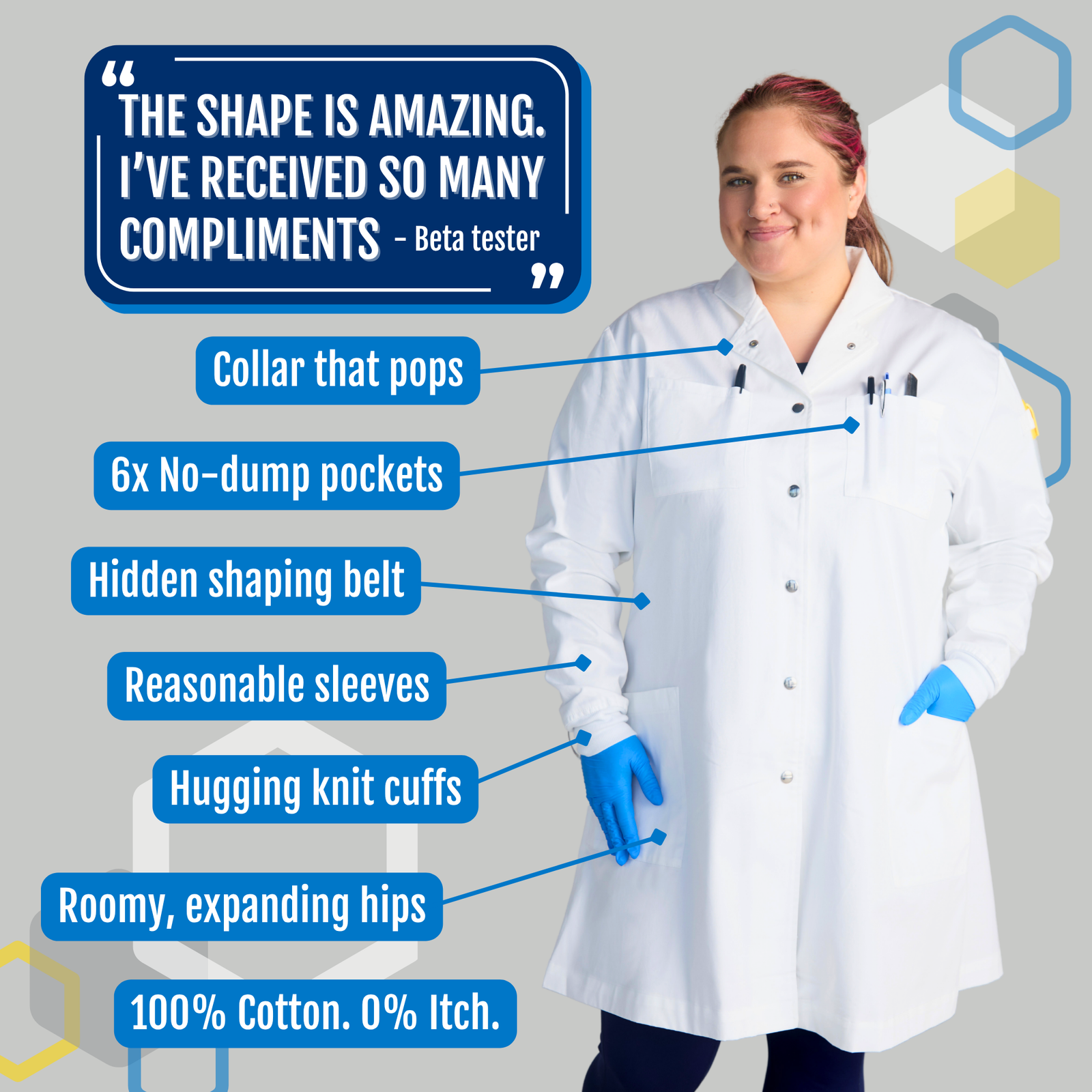
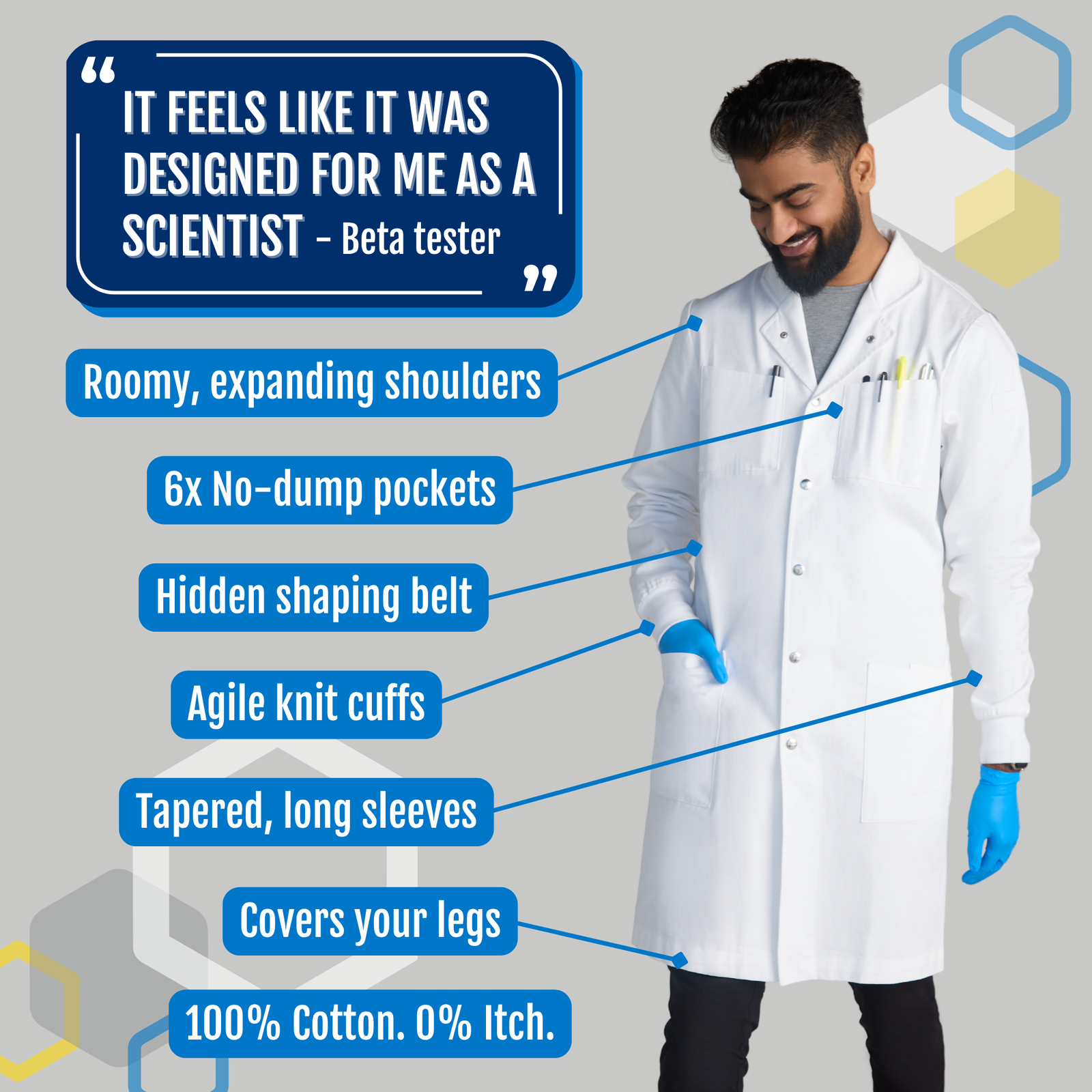
We were a little frustrated with all the "doctor"-focused options out there, so after gathering feedback from over 1500 scientists, we designed, tested, and are launching our own.
With strong metal snaps, long knit cuffs, a convertible up/down collar, more pockets than any other lab coat and even an adjustable belt to give you some shape, we really think this is going to be the best general-purpose lab coat for scientists ever made.
After 2 years of development and testing, these are now in stock and ready to ship. Visit The Lab Coat Project page here and the Amazon Store Page to see more details and options.

Lab Coats designed by scientists
Our lab coats were designed from the feedback of over 1000 scientists as a part of The Lab Coat Project. Designed specifically for scientific research, especially chemistry and microbiology labs, with high-end features at an affordable price. Buying for a group of 10 or more? Request a group order quote here to access our group discounts.


















Mad Scientist DIY Costume Ideas: How to find a lab coat to win Halloween
Looking to create a Mad Scientist costume that’s more legendary than last-minute? Skip those flimsy party-store outfits with see-through polyester and plastic buttons. No self-respecting villain would wear that garbage. The secret to nailing the Mad Scientist look is starting with a real lab coat, and we’ve got the perfect one.


The Ultimate Lab Coat Guide: 5 Types Every Scientist Should Know
After spending three years researching lab coats and surveying over 1,500 scientists in what I call "The Lab Coat Project," I've discovered something troubling: most of us are wearing the wrong lab coat. Let me break down the five major classes of lab coats you'll encounter, so you can make an informed decision that keeps you safe and comfortable in the lab.


Do Lab Coats Have to Be White?
Ever wondered why lab coats are white? Discover the surprising history behind the iconic garment and why today’s scientists might wear more than just white in the lab.