0

Your Cart is Empty

  • Add description, images, menus and links to your mega menu

  • A column with no settings can be used as a spacer

  • Link to your collections, sales and even external links

  • Add up to five columns

  • DNA (Deoxyribonucleic Acid) Plush

    12 items left

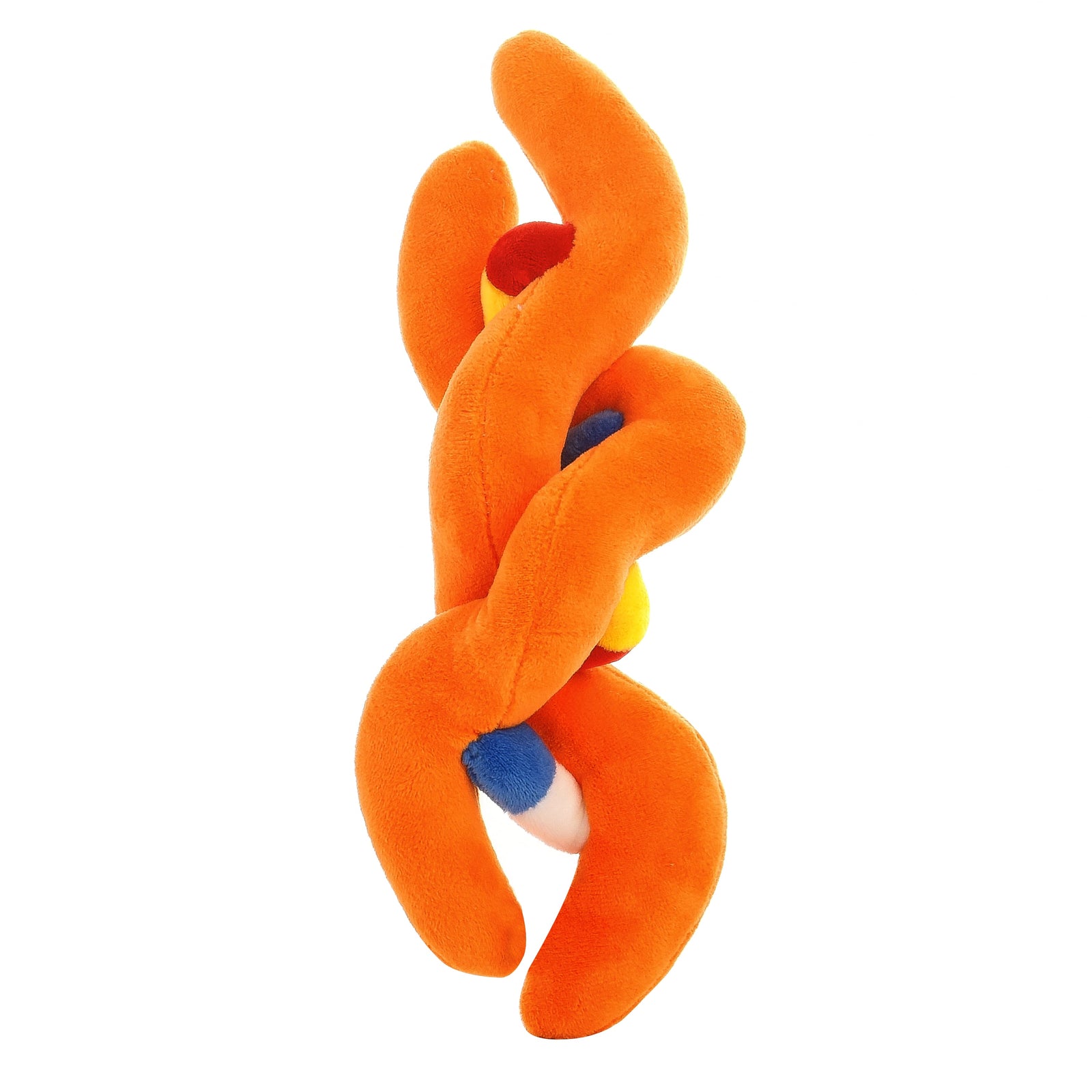
    Based on real molecular structure, this DNA double helix plush is perfect for students and educators. It provides a hands-on way to learn about genetics and what DNA is all about.

    Each DNA plush comes with an information card featuring fascinating facts about deoxyribonucleic acid — making it a unique educational gift for students, scientists, educators, doctors, nurses, ancestry enthusiasts, and anyone curious about genetics.

    Specifications

    • Size: 9" x 3" x 3"
    • Includes: Educational information card
    Materials & Care

    Plush from all new materials. Stuffed with polyester fiber fill. Surface washable: sponge with water & soap, air dry.

    Packaging

    Each plush microbe includes a printed card with fun, educational and fascinating facts about the actual microbe or cell.

    Safety Standards

    Every product meets or exceeds U.S. and European standards for safety. For ages 3 and up.

    All About DNA (Deoxyribonucleic Acid)

    FACTS:

    Deoxyribonucleic acid, or DNA, is the amazing molecular double helix that contains the genetic codes for all known life. First identified in 1869 and accurately described in 1953, its very existence provides a new understanding about how life works.

    The two spiraling strands that coil around each other are comprised of sugar and phosphate molecules which provide support for the code-carrying rows of base pairs. The four bases, adenine (A), thymine (T), guanine (G), and cytosine (C), always have a matched pair, A's with T's, G's with C's. As a result, the 4 letter code is effectively duplicated, greatly enhancing its stability and allowing for efficient replication.

    And what can you spell with this 4 letter alphabet? A series of 3 letter words which specify the 20 amino acids needed to make all of the proteins necessary for life.

    The human genome contains about 3 billion letters (bases), or a billion words (codons). These words, collected in 23 chromosomes, describe the more than 20,000 genes that are the substance of our bodies. Some genes take a few hundred words to describe, some take hundreds of thousands.

    99% of the DNA in every individual is identical, and indeed, much of our DNA is shared with every living creature on Earth.

    But the tiny variations in the words are sufficient to fashion the great diversity of creatures on the planet, and the uniqueness of every human being that has ever lived.

    More Nerdy Details

    DNA is the set of biological instructions that are unique to every living creature on Earth. Inside a person's DNA, you could find instructions for every millimeter of their body. Even though 99.9% of human DNA sequence is the same, the odds of two people having this same exact DNA profile is one in a billion!

    Where did the name come from?

    The name describes the molecule's chemical structure consisting of a sugar, phosphate, and base.

    Actual Size of the real thing

    The entire human genome is made up of about 20 thousand genes. That's over 3 billion nucleotide bases. Unwrapping all the DNA in a human body is enough to reach the moon 6000 times!

    Biological System

    Genetic / hereditary; present in every nucleated cell

    How many are there?

    About 3.2 billion base pairs per cell, in roughly 37 trillion nucleated cells in the human body

    Where It Lives

    DNA stands for Deoxyribonucleic acid. It's the genetic material and basis of life for nearly all living organisms, made of chemical building blocks called nucleotides. The nucleotides are cross-linked into double-stranded chains and packaged neatly into chromosomes. Nucleotide bases form sequences called genes, which code for proteins.

    Historical Notes

    This genetic material was first discovered in 1869 by Friedrich Miescher. Nearly a century later, in the early 1950s, James Watson and Francis Crick (working with data from Rosalind Franklin and Maurice Wilkins) described its double-helix structure.

    Fascinating Facts

    The Human Genome Project was an international collaboration to sequence and map the entire human genome. In February 2001, the International Human Genome Sequencing Consortium published the first draft of the human genome.

    Carbon-neutral shipping on all orders
    12281kg
    shipping emissions removed
    That's like...
    31438
    miles driven by an average gasoline-powered car
    We fund innovations in...
    Direct Air Capture
    Bio Oil
    Mineralization